Fynsa

La energía nuclear está nuevamente sobre la mesa de discusión. En su reciente libro “Cómo evitar un desastre climático”, Bill Gates defiende la necesidad de contar con la tecnología nuclear para generar electricidad sin emisiones de carbono y complementar a las instalaciones de energía solar, eólica e hidroeléctrica mediana y pequeña. Según Gates, hay nuevas tecnologías en desarrollo que hacen que la energía nuclear sea más segura y demanden menores inversiones. El planteamiento de Gates llega cuando la energía nuclear está en una encrucijada. Según la Agencia Internacional de la Energía, en 2019 se conectaron 5,5 GW de capacidad nuclear y se retiraron 9,4 GW, dejando la capacidad instalada global en 443 GW. Según la IEA, con el actual ritmo de crecimiento la capacidad nucleoeléctrica será de 445 GW en 2040, por debajo de los 601 GW estimados en su escenario de desarrollo sustentable (SDS) para cumplir los Objetivos de Desarrollo Sustentable establecidos por las Naciones Unidas. El endoso de Gates a la energía nuclear, sin embargo, no es compartido por algunos sectores de la comunidad científica, como el equipo liderado por Mark Jacobson en la Universidad de Stanford, quienes han calculado cómo cada país del globo puede alcanzar a generar el 80% de su electricidad a partir de fuentes renovables en 2030 (https://web.stanford.edu/group/efmh/jacobson/Articles/I/CountriesWWS.pdf)
Perspectivas de instalación de capacidad de generación nucleoeléctrica
(GW)
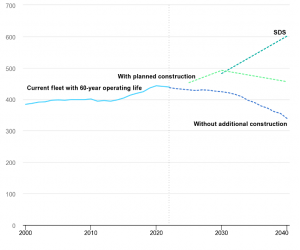
Fuente: EIA