Fynsa


Hay 2 conceptos que dominan los escenarios base para 2022. Una vuelta a la “normalidad” asumiendo que la pandemia queda atrás y un año “más volátil” a consecuencia de una normalización de la política monetaria.
En el último newsletter de 2021 comentábamos que nuestra opinión es que 2022 será el año de una recuperación mundial total y el fin de la pandemia mundial, gracias al logro de una amplia inmunidad de la población y nuevas terapias y que esto se tradujera en una fuerte recuperación cíclica, un retorno de la movilidad global y una liberación de la demanda reprimida de los consumidores (por ejemplo, viajes, servicios) y corporaciones (recuperación de inventarios, inversiones de capital y recompra), en un contexto en que la política monetaria seguirá siendo acomodaticia.
Por esta razón, seguimos siendo positivos en acciones, materias primas y mercados emergentes, y negativos en bonos.
Pero han ido apareciendo algunos riesgos… La FED se está moviendo a una línea “más dura”
Las minutas del FOMC de diciembre retratan “un Comité en marcha hacia la eliminación de la acomodación monetaria”, lo que no es una sorpresa para nadie. Ahora bien, respecto a la trayectoria esperada de las tasas de política, las minutas señalan que los participantes ven aumentos de tasas ” antes o a un ritmo más rápido” de lo que se esperaba anteriormente.
Las minutas también indicaron que los participantes continuaron viendo a mediados de marzo como una fecha de finalización apropiada para las compras netas de activos y por tanto consistente con una primera alza de tasas en la reunión del mismo mes.
Ahora bien, lo que fue nuevo en las minutas, y también fue inesperadamente en la “línea dura”, eran las pistas dadas a la forma en la normalización del balance. Si bien algunos se inclinan que los activos del balance se agotarán después de la primera subida de tasas, en general se pensó que la venta de activos ocurriría antes del despegue en relación con el episodio de 2014-17. Además, en general se consideró que el ritmo de la venta de activos sería más rápido que en la última experiencia: como recordatorio, la última vez pasaron dos años entre la primera subida de tasas y el comienzo de la contracción del balance, por lo que la Fed ahora insinúa que podría acortar esto a menos de nueve meses para que la reducción del balance comience en 2022.
Por el lado económico, la caracterización del crecimiento “se mantuvo fuerte, aunque con algunos matices”, reflejando aumentos en los casos de Covid y una resolución “más gradual” de las interrupciones de la cadena de suministro. “Muchos participantes señalaron que las nuevas variantes del virus plantean “riesgos a la baja para la actividad económica y riesgos al alza para la inflación”.
Por otra parte, “La mayoría” de los participantes consideró que la economía podría alcanzar el nivel máximo de empleo “relativamente pronto si continuaba el reciente ritmo de mejora del mercado laboral”, y “varios” participantes señalaron que “consideraban que las condiciones del mercado laboral ya eran en gran medida compatibles con el máximo empleo”. “Algunos” participantes señalaron que podría ser apropiado aumentar la tasa de fondos federales “antes de que se haya alcanzado por completo el empleo máximo”, por ejemplo, “si las presiones inflacionarias y las expectativas inflacionarias subieran de manera material y persistente”. Estos comentarios parecen coherentes de nuevo con una subida de tasas en marzo.
En particular creemos que los riesgos sobre el crecimiento son limitados, no así los riesgos sobre la inflación, toda vez que el estrés sobre las cadenas de suministro se mantiene en niveles máximos.
Con este telón de fondo, creemos que los mercados estarán vulnerables en este comienzo de año a un aumento más rápido del rendimiento de los bonos soberanos.
En efecto, las tasas soberanas en 10 años en EEUU ya cotizan en niveles de 1,75% un nivel clave toda vez que fue el nivel pivote durante todo 2021.Después de eso las tasas tienen espacio para correr fácilmente hasta niveles de 2,2%.
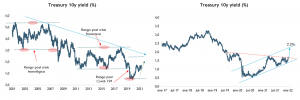
No es que una tasa en esos niveles sea particularmente problemática pensando en las valorizaciones de la renta variable, esto porque nuestras estimaciones para el S&P 500 para este año en los 5000 puntos ya consideran un treasury a 10 años en niveles más cercanos al 2,0%, pero nos preocupa la rapidez de este eventual movimiento. Dicho en otras palabras, más que el nivel de tasas de interés, al mercado le estresa los movimientos rápidos y en cortos periodos de tiempo, que puede terminar siendo el caso, dado el tono más duro establecido por la FED, los riesgos inflacionarios y un mercado laboral estrecho.
¿Y las tasas reales?
Algo notable ha sucedido en este inicio de año: mientras que las tasas del Tesoro reales se habían estado negociando en mínimos de varios meses el último día de 2021, alcanzando un mínimo de -1,13%, una indicación de que los mercados veían las perspectivas futuras de la economía como pésimas y desalentadoras, indicativo de una incredulidad crónica en la capacidad de la Fed para subir las tasas de manera decisiva: en la primera semana de 2022, las tasas reales se han disparado hasta el -0,8%, el nivel más alto desde junio.
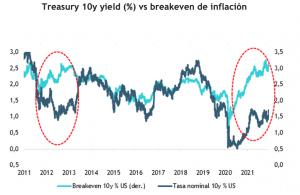
El resultado ha sido un fuerte movimiento al alza de las tasas nominales, que como comentamos cotizan en 1,75%, superando el nivel más alto del año pasado, en marzo de 2021, y el más alto desde pre-covid, porque la caída de los breakevens ha sido más que compensada por el repunte de las tasas reales.
Evidentemente este movimiento más alto (menos negativo) en reales es en respuesta a la confianza del mercado de que el crecimiento económico de EEUU puede soportar un proceso de normalización monetaria más rápido, pero también podría empezar a ejercer presión sobre las valorizaciones del mercado (compresión de múltiplos), más aun considerando que comparado con el ciclo de normalización post crisis financiera, las tasas reales siguen en niveles extremadamente deprimidos.
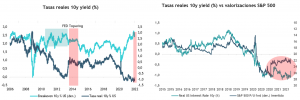
Creemos que los riesgos de correcciones han ido aumentando, lo que en cualquier caso podría entregar mejores puntos de entrada para 2022, toda vez que desde los niveles actuales el upside para la renta variable parece acotado y las valorizaciones un poco estiradas, lo que es particularmente cierto para el mercado americano y más aún en el gran sector de tecnología.
¿Nuestra recomendación? Manténgase más alejando de los sectores de crecimiento por lo menos la primera parte del año, privilegie inversiones de valor cortas en duración (y por tanto menos sensibles a alzas en las tasas de interés) y posicionamiento para una curva más empinada (sector financiero, energía), diversifique fuera de EEUU en mercados desarrollados donde las valorizaciones son más atractivas (Europa y Japón) y mantenga una estrategia muy conservadora en términos de duración en la renta fija internacional.
Finalmente, considere mantener un poco de liquidez (para buscar mejores puntos de entrada) para el resto del año.
Humberto Mora, Estrategia e Inversiones