Fynsa


So far, our scenario assumes an IPSA target of 4,900 points. We base our projections on a relatively conservative scenario in terms of valuations, recognizing that the domestic outlook will remain challenging with a packed electoral calendar that includes the constitutional process and a presidential election, but that, given the magnitude and timing of monetary and fiscal stimulus measures, falling interest rates, discounted valuations, the global weakening of the dollar, and the recovery in commodity prices, these factors would offset the domestic political and electoral risks.
Well, we’re already reaching fair value levels for the IPSA—quite a bit earlier than expected—and the question now is: Is there still value in local stocks?
Looking ahead to the rest of 2021 and taking into account the new information available, there are reasons to be a little more optimistic (or, if you prefer, “less pessimistic”)
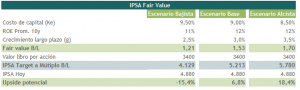
So far, we have worked with a fairly conservative valuation scenario, with a fair-value price-to-book multiple of around 1.4x (1 decile below its long-term average of 1.7x), which assumes an average profitability scenario (ROE of 11%), a cost of capital (ke) of 8.5%, and long-term growth (g) of 3.0%.
That said, let’s acknowledge the higher implied risk of investing in local stocks with a higher discount rate (+50 bp) at 9.0%, but with an additional return scenario of +100 bp (ROE of 12%), for the same long-term growth rate (g=3.0%), this translates to an IPSA of around 5,200 points, which implies a P/B ratio of 1.5x. (see Table 1)
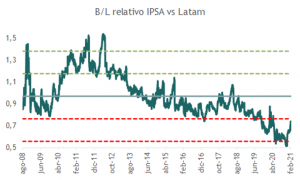
We obtain the same results when taking a relative perspective on the region. Despite the IPSA’s recovery in recent months, it still appears attractive compared to Latin America and even more so compared to emerging markets.
We believe that such a wide discount relative to the region is no longer justified, given that we will grow more, have demonstrated better management of the pandemic, and—not to mention—our successful vaccination campaign. Today, the IPSA is trading at a 25% discount to Latin America in terms of P/E ratio. (See Chart 1)
IPSA Baseline Scenario and Risk Scenarios
IPSA Multiple Stock Index Book Related to Latin America