Fynsa


There’s a lot of focus on interest rates, but what about corporate earnings in an environment of improved growth expectations? The significant easing of monetary and fiscal policy during the current recession helps explain why stocks have rebounded so quickly from their March 2020 low. We believe we are still in the early stages of a new bull market. Although there are risks of a correction, the equity markets have shown that any correction is a buying opportunity.
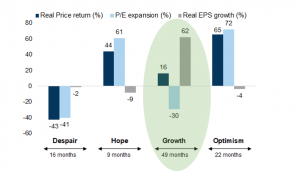
The strong initial rally in the stock markets between March and September of last year, driven by rising valuations, is very typical of the initial “hope” phase of a bull market, which generally begins during a recession when earnings are still falling.
This phase is usually followed by what we call the “growth” phase, which is what we expect to see this year, as global stocks are generating earnings growth of around 30%.
The transition between the two phases is often marked by increased volatility, which is what we are seeing today in connection with the rise in interest rates.
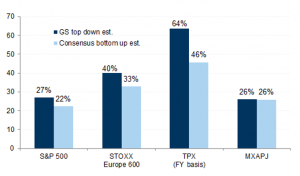
While we recognize the risk that higher interest rates pose to somewhat stretched valuations, we question why the focus is solely on that factor and not on the strong rebound in corporate earnings expected for this year (see Chart 1) and next. As Chart 2 shows, the growth phase continues to generate positive returns for equities, driven by a strong earnings recovery, partially offset by a compression in valuations.
Top-down vs. bottom-up consensus estimates for 2021 EPS growth
We are currently entering the “Growth” phase of the new cycle