Fynsa


As for claims of bubbles (such as those surrounding GameStop or Bitcoin), no major financial imbalances are apparent. Furthermore, evidence of excessive speculation in some markets does not imply that there is a bubble in risky assets in general. It is worth remembering that cryptocurrency went through a boom-and-bust cycle earlier in 2016–18 without broader implications for other asset markets and both examples remain a small part of most portfolios, so they should not necessarily be viewed as a barometer of general investor sentiment or asset valuations.
And as we showed earlier, despite the euphoria in some market sectors, the prices of some risky assets, including stocks in the UK and Europe, remain below their pre-pandemic levels.
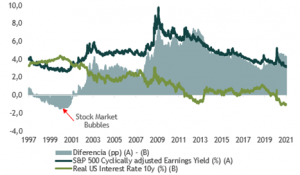
That said, the S&P 500’s earnings yield is still well above 10-year real yields. In other words, the current valuation of U.S. equities can be justified in the context of negative real interest rates.
Previous crashes in the U.S. stock market, such as in 2000 when the dot-com bubble burst, have been preceded by a period in which stock prices rose to the point where the earnings yield fell below the real yield on 10-year U.S. Treasury bonds. But today, the S&P 500’s earnings yield is still well above 10-year real yields.
Relative valuations of stocks and U.S. Treasury bonds