Fynsa


Venture capital is a type of financing that provides capital to startups in exchange for a small percentage of ownership.
These companies are in an early stage of development, characterized by a high degree of uncertainty and associated risk—which is where the name of this type of strategy comes from—but they also offer significant potential for growth and return on investment.
One of the fundamental pillars of Venture Capital is the impact that these investments generate in society, where in addition to providing financing options to many companies, they have an impact on the economies of different countries. According to a study by Oxford Economics, for every dollar invested in VC, 7 dollars remain in the economy of that country.
How is it different from private equity?
These strategies differ primarily in the percentage of company ownership that each acquires. On the one hand, with private equity funds, the investor takes control of the company, betting on its growth and maturation with the goal of eventually selling it. In contrast, venture capital funds acquire smaller stakes in companies that are still in the development stage, betting on selling their stake once the company begins to mature.
The VC Fund Industry
Globally, venture capital funds have been gaining prominence; according to data from Preqin, there are currently 2,469 VC funds with AUM of more than USD 200 Bn, representing a 21% increase over the past year.
The average return on venture capital funds globally has been around 18% per year over the past year and 12.5% per year over the past five years.
In Latin America, venture capital (VC) funds have experienced explosive growth over the past three years, during which time the capital invested in these funds has doubled, reaching a total of USD 4.1 billion by 2020.
This growth is largely due to the number of success stories in this part of the world, with 26 companies having achieved “unicorn” status (valued at more than USD 1,000 MM) and 240 are classified as “Centaurs”—companies currently valued at more than USD 100 MM that are expected to achieve unicorn status in the near future. As a result, the region has gained prominence and is considered a hotspot for startup investment opportunities.
What's going on in Chile?
In Chile, there are currently no public venture capital (VC) investment funds; there are 48 active funds, all of which are private and receive significant support from CORFO.
Investment in this type of strategy has been steadily increasing, reaching a total investment of USD 593 M as of 2020—an amount that has increased by 6% compared to 2019 and by 68% over the past five years.
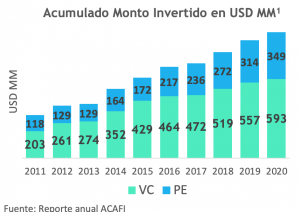 As mentioned above, CORFO has been a cornerstone in the development of this type of investment, providing support and financing, which has totaled USD 349 million invested in these types of funds.
There are 374 Chilean companies that have benefited from this type of investment, with the sectors that have grown the most being information technology (50%) and fintech (20%).
There have been several success stories in Chile, among which three companies that achieved “unicorn” status stand out: Crystal Lagoons, Cornershop, and Orca Bio. However, there are many more that have “centaur” status and are expected to become unicorns in the near future, including Fintual, NotCo, Betterfly, Poliglota, Protera, and PhageLab.
Venture capital is emerging as an attractive investment alternative, offering higher expected returns than other options and shorter investment horizons. In Chile, there have been several success stories, demonstrating that there are many companies and ideas that fail to get off the ground due to a lack of financing—an issue that could be resolved through venture capital investment funds that invest in these companies, thereby achieving success together and helping to consolidate this investment strategy in the country.