Fynsa


Colaboración NUAM
La reciente alza de aranceles en Estados Unidos, conocida como “Día de la Liberación”, ha sometido a los mercados globales a un importante estrés. El índice de volatilidad (VIX) alcanzó los 52 puntos pocos días después del anuncio del Presidente Trump, cifra equivalente a la registrada en el pico de la pandemia a inicios de 2020 y muy cercana a los 59 puntos que marcó durante la crisis subprime.
En paralelo, el principal índice de Estados Unidos, el S&P 500, tocó los 4.985 puntos el 9 de abril de este año, lo que se aproxima a los 4.975 puntos de hace 12 meses atrás.
Mientras tanto, en algunos mercados de Latinoamérica como el mercado nuam, que contempla las Bolsas de Santiago (BCS), Bolsa de Valores de Colombia (BVC) y a la Bolsa de Valores de Lima (BVL), el efecto ha sido más moderado, especialmente considerando el rally que venían experimentando algunos índices.
En Chile, el S&P IPSA alcanzó un máximo histórico de 7.700 puntos poco antes del anuncio del mandatario estadounidense, pero retrocedió hasta los 7.165. En Perú, el índice Perú Select de la Bolsa de Valores de Lima marcó un mínimo de 756 puntos tras haber escalado hasta 825. Por su parte, en Colombia, el COLCAP se acercó a los 1.540 puntos, un nivel máximo registrado en enero de este año.
En esta misma línea, el comportamiento de las 10 empresas más grandes del mercado nuam por capitalización bursátil a diciembre de 2024, es un ejemplo de la resiliencia del mercado regional.
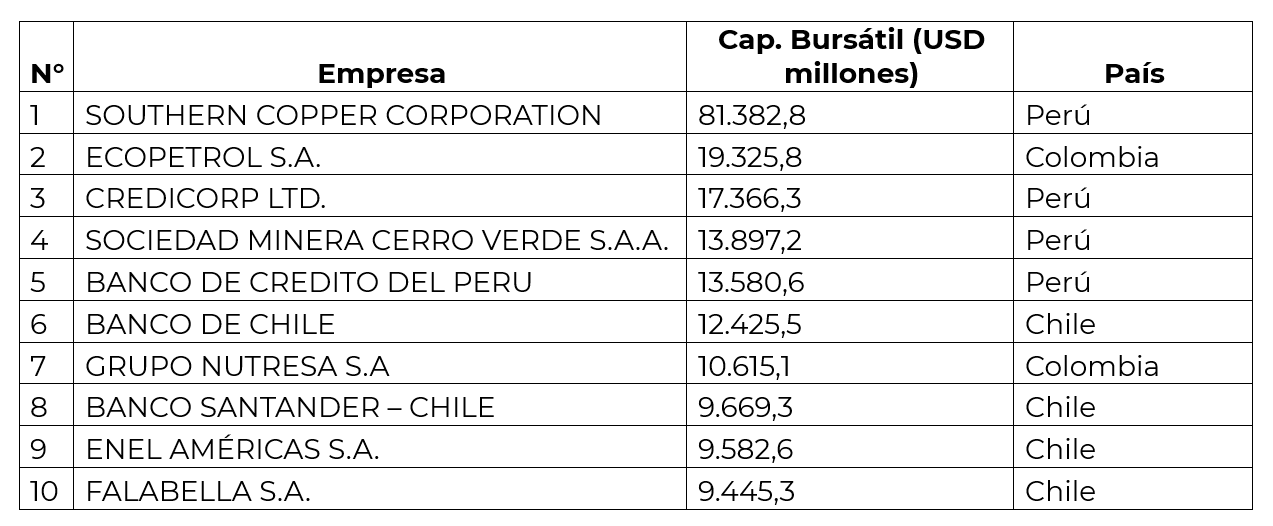
Dentro de estas empresas, en el caso de Colombia, Ecopetrol fue la más afectada en los primeros días del mes con una variación del -13,19%, aunque comenzó a recuperar sus pérdidas rápidamente. Grupo Nutresa acumuló una pérdida de -1,04% en el mismo periodo.
En Perú, Southern Copper cayó cerca del 14% tras el anuncio de los aranceles, Credicorp perdió un 10% y Minera Cerro Verde registró un retroceso de -4,76%. Banco de Crédito del Perú tuvo una disminución cercana al 4,11%.
En Chile, Falabella registra una variación mensual acumulada de -0,84%, cifra que ha ido superando con creces al cierre del miércoles. Enel Américas marcó -3,15% en lo que va del mes, pero con un alza sostenida luego de la crisis. Por el contrario, Banco Santander (BSANTANDER) y Banco de Chile (CHILE) mantuvieron rendimientos positivos, con +1,28% y +0,79% respectivamente en lo que va del mes.
Pese al entorno de alta volatilidad, el comportamiento de los mercados nuam reafirma la idea de que América Latina puede convertirse en un refugio y oportunidad de inversión cuando la economía global enfrenta fuertes presiones. Las bolsas de la región han mostrado una recuperación más rápida y menos pronunciada en comparación con el mercado estadounidense, respaldadas por empresas que, en muchos casos, han sabido sortear la incertidumbre global gracias a fundamentos sólidos y un creciente apetito inversor regional.
A medida que continúe la tensión comercial, será clave observar la evolución de estas compañías y los flujos de capital en las bolsas de Latinoamérica, pues su desempeño seguirá ofreciendo señales sobre la fortaleza y resiliencia de la región frente a los desafíos externos.
Nuam