Fynsa


Latin American foreign trade is experiencing an unusual period. According to a report by the Inter-American Development Bank (IDB), the value of the region’s goods exports rose 15.7% year-over-year in the first quarter of 2026, driven by a combination of higher shipment volumes and higher prices for several of its flagship products. This result extends the 7.8% growth recorded in 2025, suggesting that the export cycle is not a one-off phenomenon but rather a trend that has been gaining momentum for over a year.
Behind the aggregate figures lie very different trends depending on the commodity. Gold led the gains with a 63.9% year-over-year increase, followed by copper (26.8%), oil (12.2%), soybeans (10.1%), and iron ore (5.7%). At the other end of the spectrum, coffee fell 21.1% and sugar dropped 24.2% compared to the same period last year. The IDB attributes these divergences to geopolitical and changes in global supply and demand conditions, confirming that mining and energy accounted for much of the momentum, while agribusiness showed a more mixed performance.
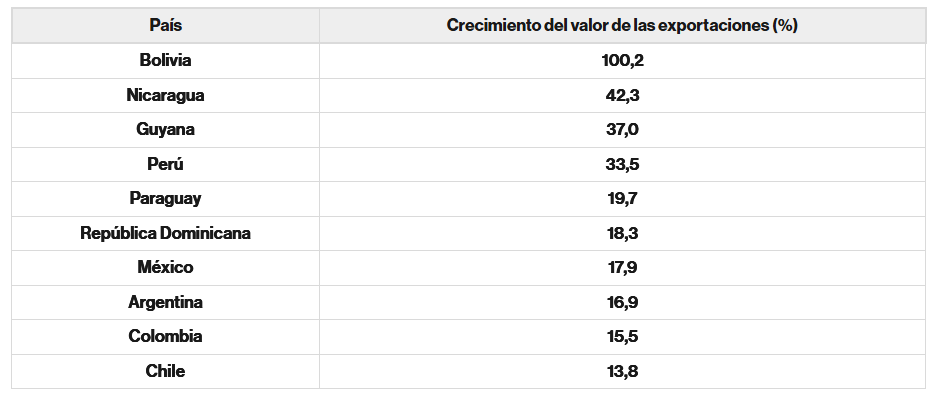
At the country level, Bolivia topped the list with a 100.2% increase in exports, driven mainly by Asian demand: China and the rest of the continent together accounted for more than 70% of that increase. It was followed by Nicaragua (42.3%), Guyana (37%), Peru (33.5%), and Paraguay (19.7%). Among the region’s largest economies, Mexico grew by 17.9%; Argentina by 16.9%; Colombia by 15.5%; Chile by 13.8%; and Brazil by 7.1%. Venezuela and Belize were the only countries to experience declines during the period, by 8.7% and 9.1%, respectively.
What is interesting is that the rebound does not depend on a single trading partner. The IDB report shows that demand increased simultaneously across the main destinations for Latin American exports: China (24.5%), the rest of Asia (24.4%), the European Union (18.6%), and the United States (13.7%). Paolo Giordano, lead economist in the IDB’s Productivity, Trade, and Innovation Sector and coordinator of the report, highlighted that the region is demonstrating a growing capacity to adapt, even in a global environment that remains uncertain and volatile for international trade.
The IDB is cautious about what lies ahead. Although the outlook remains positive, it warns that trends in international prices could become a double-edged sword: they benefit countries that export raw materials, but put pressure on those that depend on energy and food imports. Rising fertilizer and transportation costs add another layer of complexity to the picture. For the institution, the real challenge is not sustaining the favorable cycle, but rather taking advantage of it to drive reforms that diversify the region’s integration into the global economy and strengthen its resilience in the face of external shocks that are increasingly difficult to anticipate.
Fynsa