Fynsa


De acuerdo con el reporte de GFK al cierre del segundo trimestre del 2025, el mercado de viviendas nuevas en el Gran Santiago mostró señales de reactivación en términos de ingreso de nuevos proyectos. Entre abril y junio, se incorporaron 32 nuevos proyectos (11 proyectos de casas y 21 de departamentos), marcando el nivel más alto desde el primer trimestre de 2024, cuando se registraron 39 ingresos. No obstante, esta cifra sigue siendo inferior a los volúmenes de ingreso observados antes de la pandemia.
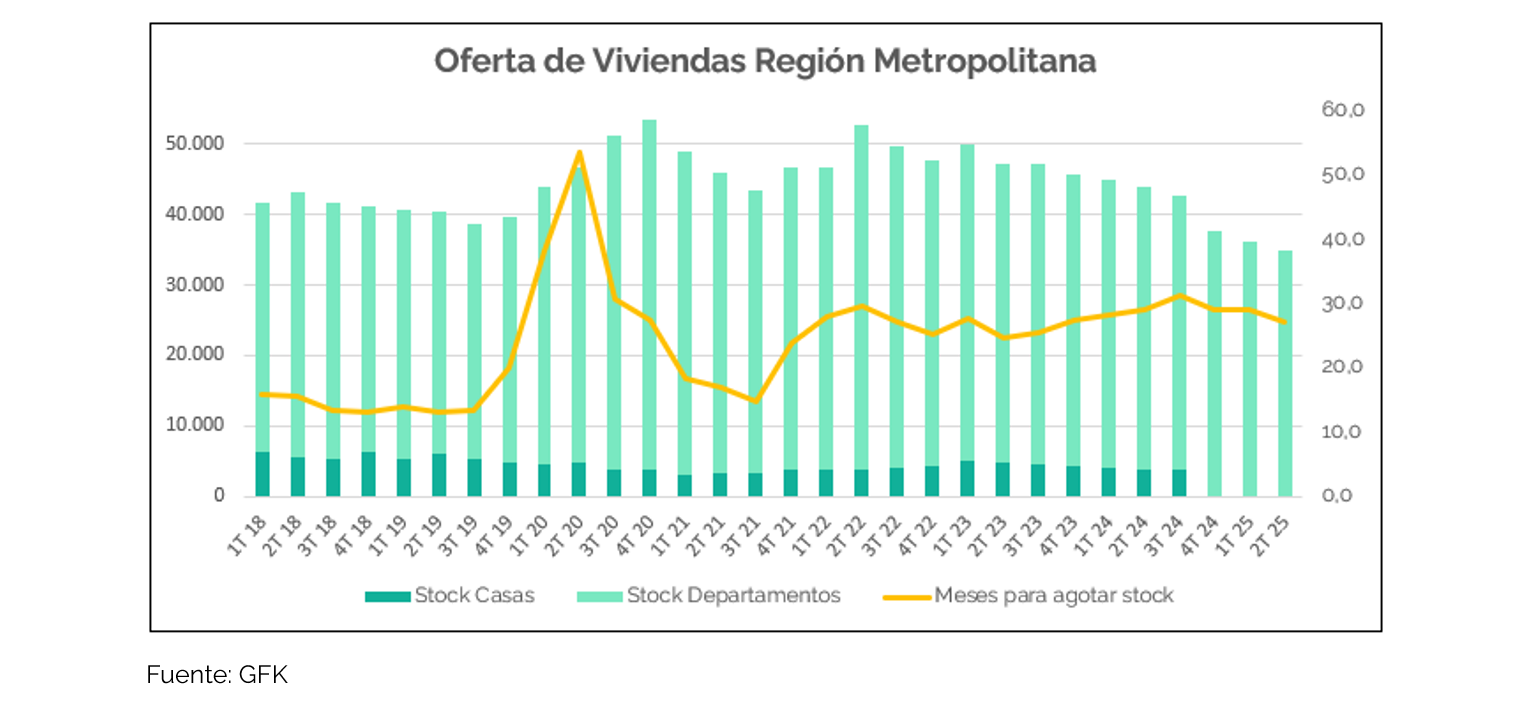
En cuanto a la oferta, vemos que el stock al 31 de junio es de 39.273 unidades (o 197.6 millones de UF), un 2,1% menor al trimestre anterior, y un 10,8% menor al mismo periodo del año anterior. Al ir al detalle, observamos que el número de departamentos en stock es de 34.946 unidades, las cuales se concentran mayoritariamente en las comunas de Santiago, Ñuñoa y La Florida. Entre las 3 comunas, se concentra el 53% de la oferta total de departamentos. En el mercado de casas, el stock disponible es de 4.237 unidades, concentradas mayoritariamente en las comunas de Colina, Puente Alto y San Bernardo, las cuales en conjunto concentran el 48% del stock total de casas. Por plazo de entrega, tanto en casas como en departamentos, el mayor plazo de entrega se encuentra con entrega inmediata, representando un total de 26,8% del total de departamentos y un 29,4% del total de casas disponibles.
Por el lado de la venta, durante el 2do trimestre del 2025 se vendieron 4.363 unidades (o 20,9 millones de UF), un 4,8% más que el trimestre anterior, y un 4,6% menos que en el mismo periodo del año 2024. Desglosando las cifras, en el 2T 2025 se vendieron 3.894 departamentos y 469 casas. En el caso de los departamentos, las comunas con mayor volumen vendido fueron Santiago, La Florida y Ñuñoa, con un 52,1% del total de departamentos vendidos, mientras que, en el mercado de casas, fueron las comunas de Colina, Buin y Puente Alto, concentrando un 51,8% del total. Por plazo de entrega, la entrega inmediata concentra el mayor porcentaje de la venta trimestral tanto en departamentos como en casas, con un 45,5% y un 44,3% del total de las ventas, respectivamente.
La velocidad de venta promedio por proyecto fue de 1,3 unidades mensuales (1,7 ventas mensuales en el mercado de departamentos y 0,8 en el mercado de casas), por lo que los meses para agotar stock se ubican en 27 meses considerando el mercado total (27 meses para el mercado de departamentos y 28 en el mercado de casas).
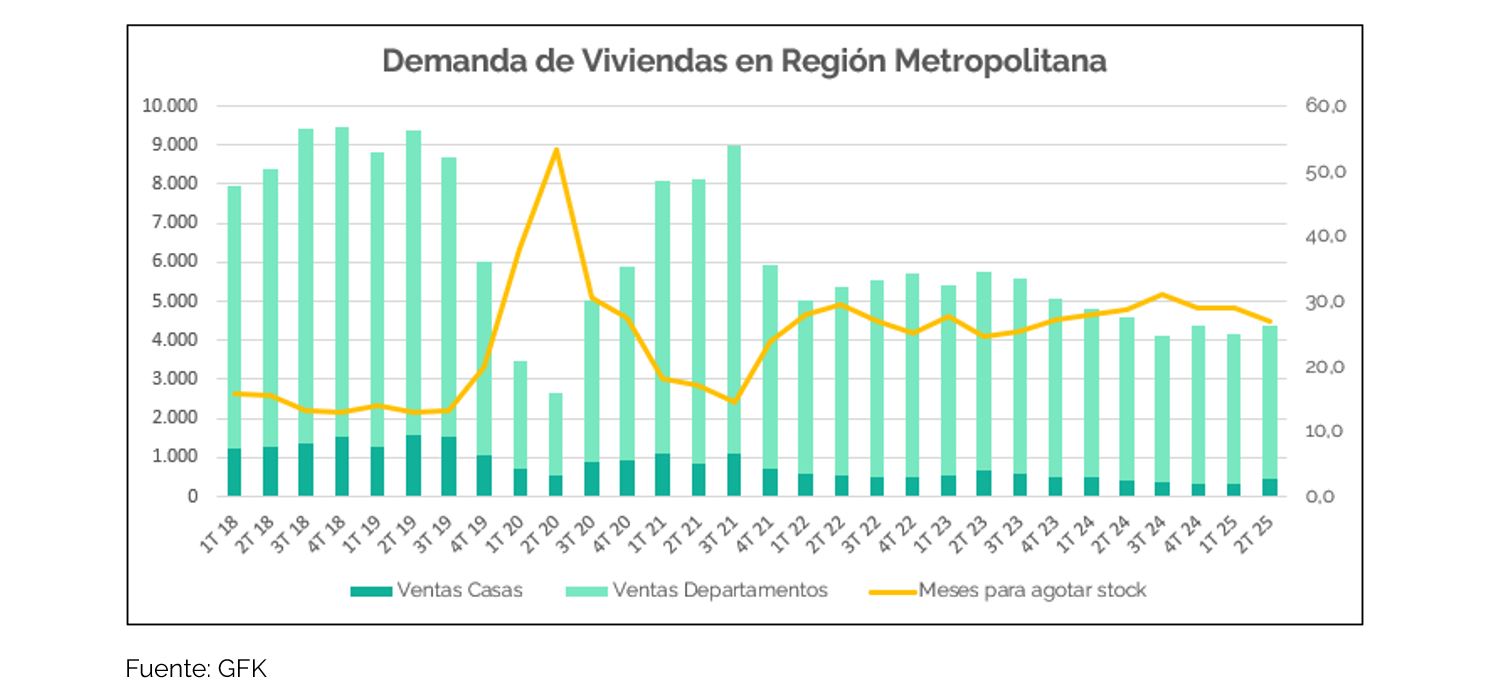
En síntesis, el balance del primer semestre de 2025 muestra un mercado de viviendas nuevas en el Gran Santiago que, si bien aún refleja síntomas de desaceleración, comienza a evidenciar signos de recuperación. La contracción anual en ventas y stock da cuenta de un ajuste moderado, pero el repunte en las cifras trimestrales – especialmente en la velocidad de venta y el ingreso de nuevos proyectos – da ciertas luces de un cambio de tendencia.
De cara al segundo semestre, todo indica que el principal catalizador será la reciente implementación de la Ley de Subsidio al Dividendo, que ya comienza a impactar el mercado con más de 500 solicitudes aprobadas y más de 2.000 en proceso, según datos de la Asociación de Bancos e Instituciones Financieras (ABIF). Este instrumento, que subsidia hasta 60 puntos base en la tasa de los créditos hipotecarios para viviendas nuevas de hasta UF 4.000, tiene el potencial de dinamizar la demanda, reduciendo barreras de acceso al financiamiento hipotecario y acelerando decisiones de compra postergadas.
En este contexto, si bien la recuperación aún es incipiente, los datos del segundo trimestre consolidan la expectativa de un segundo semestre más activo, impulsado por mejores condiciones de acceso al financiamiento, mayor dinamismo en el desarrollo de proyectos y una gradual recomposición de la confianza tanto de compradores como de desarrolladores.
Sebastián Mahave
Portfolio Manager Inmobiliario Fynsa AGF