Fynsa

The selection of assets to obtain returns is a complex and challenging task. In the investment world, it is not uncommon to find people who, despite having dedicated themselves to the study and analysis of markets, fail to obtain the expected results. On the other hand, the digestive process of cows lacks the same difficulty and sophistication: these ruminant animals spend their time grazing in pastures, discarding what they have ingested without a clear pattern... or so it seems at first glance.
But what do cows have to do with traders? traders? Today we will explore a curious experiment conducted by Norway's state broadcaster, NRK. In a 2016 program, a stock market investment contest was organized, pitting teams of vast pedigreetwo local stockbrokers, an astrologer, two influencers and, of course, a small herd of cows. Each team had a budget of 10,000 Norwegian kroner (about US$ 1,000) to see who could achieve the best results.
Before the experiment began, Gullros, the lead cow, and her team of portfolio managers were taken to a grid in a field. There, the production team had laid out a grid with the 25 stocks that make up Norway's OBX index. The cows' stock selection would be defined in a rather unusual way: according to where they chose to relieve themselves..
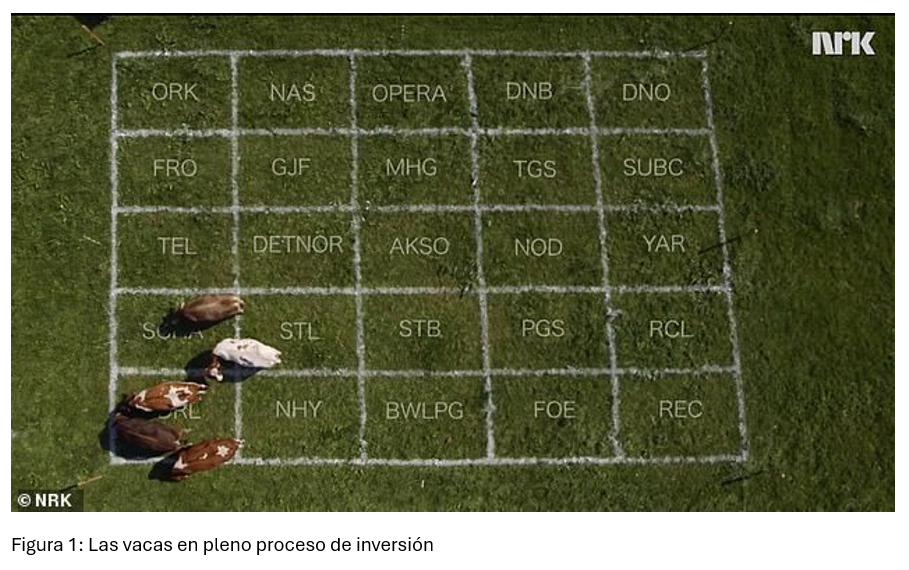 The resulting cow portfolio included Aker Solutions, Statoil and Fred Olsen Energy, all companies in the energy sector. Schibsted, a major Norwegian media company, provided the necessary diversification. The Aker share was selected as "high conviction", thanks to the clear preference of the cows.
On the other hand, the brokerage team was very confident in its experience and expertise, and opted for a diversified portfolio that included salmon farms, DNB - the largest Norwegian bank - and Royal Caribbean, a cruise operator.
The astrologer also held a similar optimism, influenced by the fact that that year corresponded to the "Year of the Goat" in the Chinese calendar, a symbol of family, friendship and togetherness. His portfolio consisted of DNB, an airline and a food conglomerate.
The influencers admitted early on that they did not know the companies in the index and, somewhat bewildered, made decisions based more on their intuition. They opted mainly for Royal Caribbean, thinking how good a vacation would be for them, and added a salmon company to their portfolio.
The purpose of this type of exercise is to highlight two key points. First, the difficulty involved in beating a market, and although it may be possible to beat it in a specific window, achieving long-term consistency is a complex task. Secondly, the valid question arises as to whether beating the market is the result of skill or simply luck.
Experiments like this have been carried out on several occasions since economist Burton Malkiel, in his 1973 book "A Random Walk on Wall Street"suggested that a blindfolded monkey throwing darts could achieve the same success as the experts. Since then, similar exercises have been conducted with monkeys, cats, dogs and rats.
In 1984, Warren Buffett illustrated this concept with a very graphic example. Buffett proposed to imagine that all Americans (some 225 million at the time) flipped a coin every day, betting a dollar on whether it would land heads or tails. According to the statistic, in 20 days there would be 215 people who guessed right every day, making a million dollars. We can imagine these "flippers" traveling around the country giving lectures on how to flip coins consistently and debating with professors, defending their argument: "If it's so hard, why are there 215 of us?
In recent years, and in the spirit of the above, Warren Buffett won a $1 million bet against the investment group Protege Partners, Warren Buffett won a one million dollar bet against the investment group Protege Partners. The bet revolved around his thesis that various funds would not be able to outperform the S&P 500 over a 10-year period.
Back to the Norwegian experiment. Three months into the contest, the brokers managed to outperform the benchmark OBX (which returned 5% over the period) with a return of 7.28%. The surprising thing? Their return was practically equal to that of the cows, which reached 7.26%. On the other hand, the astrologer turned out to be the worst of all. The winners of the exercise were, unexpectedly, the influencerswho obtained a return of more than 10%.
Towards the end of the program, the already surprising result was overshadowed by even more unexpected news. The organizers of the experiment revealed their own portfolio, which had returned 24%, far outperforming the entire sample. The "secret" behind this success was that they created 20 combinations of different portfolios, eliminating the worst performers and leaving only the best performers. This approach introduced the concept of "survivorship bias," which explains how poorly performing funds are closed out, allowing managers to boast high returns that do not reflect their actual performance.
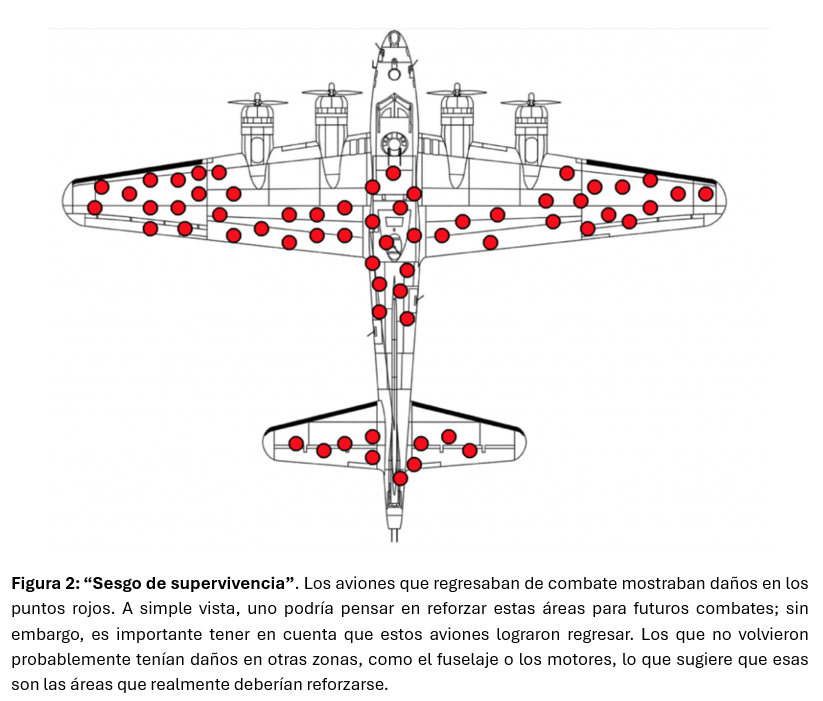
Finally, beyond the entertaining story of cows outperforming the market, it is important to reflect on two key points. First, it is worth noting that the duration of the experiment was only three months, which is very different from achieving long-term consistency. Secondly, in the practice of promoting funds based on their past performance, it is essential to remember that these results do not guarantee future returns and may be mere "snapshots", especially by fund managers with a large number of funds. It is always good to keep in mind that investing based solely on these results, without understanding the underlying reasons, can be as irrational as a cow defecating in a meadow.
Gabriel Haensgen
Senior Analyst Fynsa Financial Funds AGF