Fynsa


The complex scenario that the real estate market is experiencing, specifically in the traditional development of homes for sale, is not new. The market has stocks close to historical highs and a sluggish demand, hit by a scenario of high interest rates and greater restrictions to access mortgage loans.
At the close of March 2024, the housing stock in the Metropolitan Region stood at 44,961, and, while somewhat down from the all-time high at the close of the fourth quarter of 2020, where it stood at 53,474, sales continue to be historically low in terms of units, with quarterly sales at 4,814, the lowest figure since the fourth quarter of 2008 at the height of the subprime crisis.The first two quarters of 2020, at the height of the pandemic, when sales rooms were unable to operate and digital sales had not yet gained the momentum they have today, were left out.
If we look at how the stock and sales data relate to each other in relative terms, and focus on the months-to-stock-out (MAS) indicator, it shows us more clearly where the industry stands today compared to previous years. Considering this indicator (MAS) over the last 20 years, the quarterly median is 13.0x and the average stands at 15.2x. Furthermore, the indicator has been above 20.0x -evidencing a low absorption scenario- in only 16 quarters; 2 during the subprime crisis, the fourth quarter of 2008 and the first quarter of 2009, while the remaining 14 quarters have been above 20.0x.The remaining 14 quarters have occurred since the first quarter of 2020, covering 14 of the 17 quarters since then, and evidencing the complex scenario that the real estate market continues to experience.
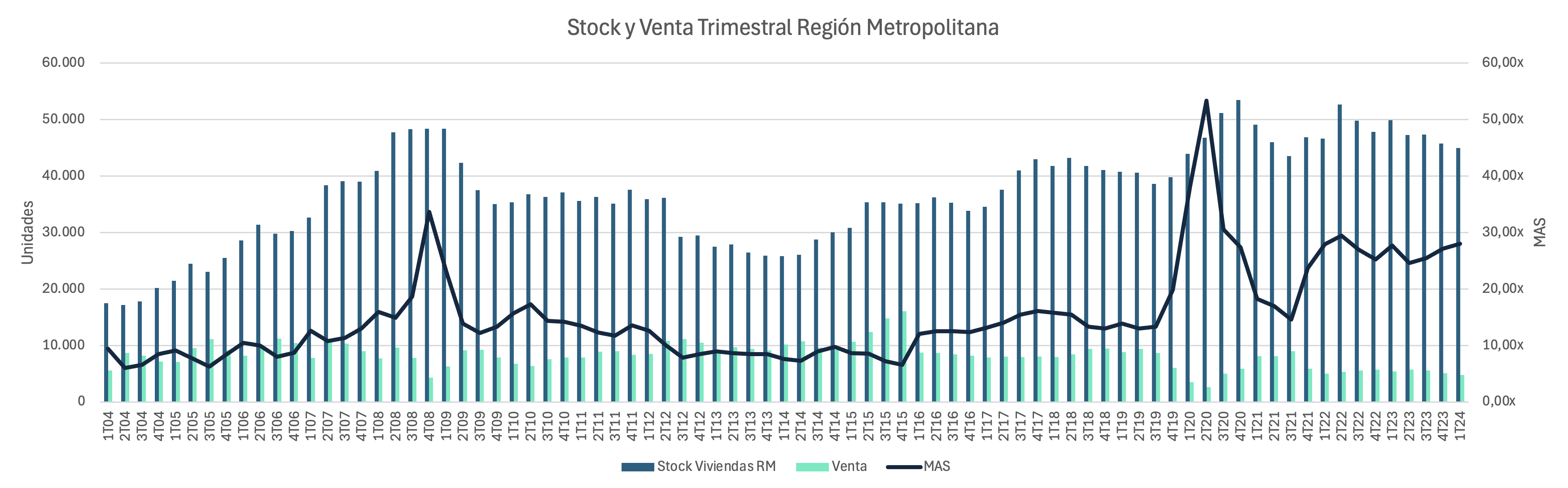
This is evidence that we are in a cycle where supply and demand are not meeting. We are in a cycle where supply and demand are not meeting. On the supply side, building permits requested for new housing have dropped significantly, to 4,125 units during the first quarter of 2024, falling 15.7% compared to the first quarter of 2023 (4,893 units) and 60.8% compared to the first quarter of 2022 (10,531 units), and being lower than the absorption of 4,814 units during the period, while the behavior of demand depends more on lowering the long-term interest rate for mortgage loans.
Given the above, if we consider the interest rate for mortgage loans as an exogenous variable, we see that the market should tend to normalize on the supply side, unless the political world intervenes with measures such as VAT exemption for housing. the market should tend to normalize on the supply side, unless the political world intervenes in the market with measures such as the VAT exemption for housing, which would have an immediate impact on price and demand.which would have an immediate impact on prices and demand. Other measures that have been proposed, such as a more efficient regulation and control of permitting, would have a more medium and long term impact.
Ulises Hamasaki
Portfolio Manager Real Estate Fynsa AGF