Fynsa


Los depósitos a plazo (DaP) son instrumentos emitidos por instituciones financieras bastante utilizados por el público en general. Ofrecen al cliente la posibilidad de ajustar el valor de su dinero en el tiempo prácticamente sin riesgos, aparte de la posibilidad de que la institución donde contrate el producto quiebre o incumpla sus pagos. Esta rentabilidad está directa y principalmente relacionada con el nivel de la Tasa de Política Monetaria que establece el Banco Central. La TPM es una de las herramientas clave que utiliza el ente para cumplir con su mandato de estabilidad de precios, aumentándola cuando las expectativas de inflación se ubican por sobre la meta y reduciéndola cuando esta se encuentra por debajo, de forma que desincentive e incentive la actividad, respectivamente.
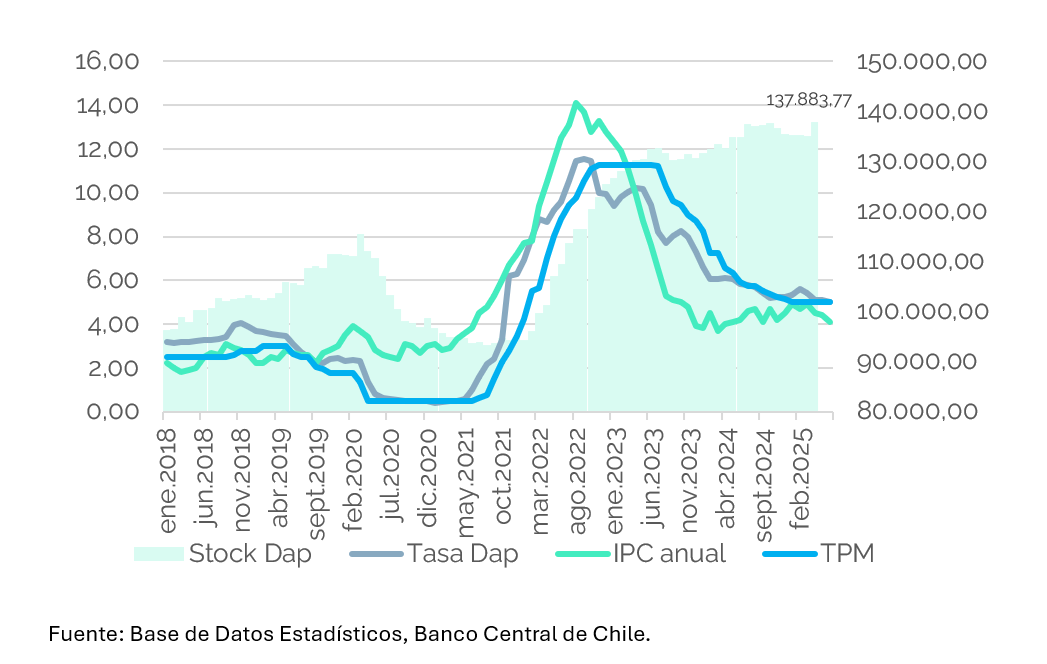
En términos históricos, el periodo previo a la pandemia se caracterizó por una inflación acotada que se encontraba por debajo de la medianía del rango meta del Banco Central, promediando una variación anual de 2,43% en 2018 y de 2,56% en 2019. En estos años la tasa de los DaP promedió 3,42% y 2,96% respectivamente. Luego con la pandemia, vino la necesidad de impulsar la actividad en vez del ahorro y con ello la TPM bajó a 0,5%, implicando una baja en la tasa de los DaP a 1,07%.
El Covid conllevó también restricciones de oferta y exceso de efectivo a raíz de los retiros de los fondos previsionales, que se tradujeron en aumentos significativos en la inflación. De hecho, en 2022 la inflación anual promedió 11,6% y en 2023 un 7,68%. Para que ésta bajara a niveles cercanos a la meta, el Banco Central optó por subir la TPM gradualmente hasta un 11,25% en noviembre de 2022, lo que se tradujo en alzas también en las tasas de los DaP, que promediaron un 9,67% en 2022 y 8,88% en 2023. Dado este buen nivel de tasas y el exceso de efectivo circulante que había en la economía, el stock invertido en DaP aumentó de forma.
Sin embargo, la tasa que ofrecen los DaP va en franca retirada. Si bien hoy se pueden encontrar depósitos con una tasa anual en torno a 5%, dado que la inflación va convergiendo algo más rápido a lo estimado a la media del rango meta del Banco Central, hay espacio para que éste recorte la tasa de referencia y la veamos en torno a 4% o 4,25% en el horizonte de política monetaria, es decir, en los próximos dos años. Con ello, la tasa de los DaP seguirá bajando y su atractivo relativo a otros productos de renta fija será menor.
Llama la atención que desde el 2023 a la fecha, la tasa de los DaP ha bajado a la mitad y el stock invertido en estos instrumentos se ha mantenido relativamente constante. ¿Qué pasa con estos participantes que se mantienen invertidos en DaP a pesar de la menor rentabilidad?
Pueden ser agentes de mercado que no están siendo atendidos correctamente o quizás personas con baja sensibilidad a la rentabilidad esperada. Sea cual sea el caso, el llamado es a buscar alternativas más rentables antes que sea tarde.
En Fynsa contamos con fondos de inversión que se presentan como opciones rentables para estos clientes. Si el objetivo de inversión es minimizar riesgo y preservar el valor del capital, el Fondo de Inversión Fynsa Deuda Chile es la mejor alternativa, al fusionar de manera óptima la exposición al devengo de inflación y ganancias de capital en un entorno donde se esperan recortes de TPM en el horizonte próximo.
Por otro lado, si el horizonte de inversión es relativamente mayor y existe apetito por algo más de riesgo, el Fondo de Inversión Fynsa Deuda Táctica es la mejor opción, con un portafolio algo más largo que ofrece exposición a una parte de la curva de tasas de interés que mantiene espacios para la apreciación de capital, que se vería fuertemente beneficiado de un aumento en la actividad local.
Conoce más sobre nuestros fondos aquí.
Ciro Giraldez
Portfolio Manager Renta Fija Fynsa AGF